
What is Machine Learning?

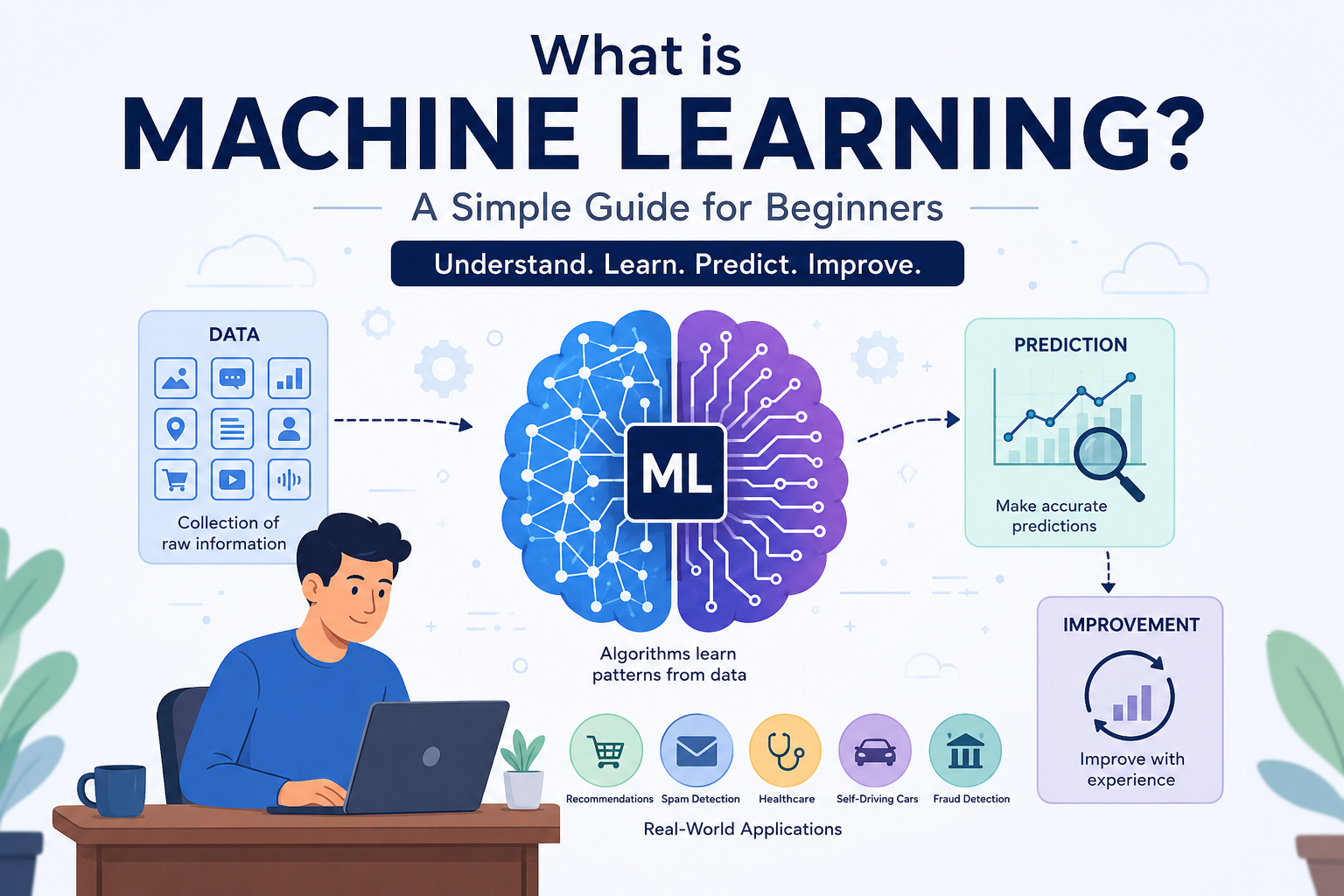
What is Machine Learning? A Complete Beginner’s Guide (2026)

Quick Summary
Machine Learning (ML) is a branch of Artificial Intelligence (AI) that enables computers to learn from data and improve their performance without being explicitly programmed for every task. Instead of following fixed instructions, machine learning models discover patterns, make predictions, and continuously improve as they process more information.
Table of Contents
- What is Machine Learning?
- A Brief History of Machine Learning
- How Machine Learning Works
- Machine Learning Workflow
- Why Machine Learning Matters
- Key Takeaways
What is Machine Learning?
Imagine teaching a child to recognize cats.
Instead of explaining every possible feature—such as ear shape, eye color, tail length, and fur texture—you simply show hundreds of pictures of cats. After seeing enough examples, the child naturally begins identifying cats, even those never seen before.
Machine Learning works in much the same way.
Rather than programming every rule manually, developers provide data. The computer studies the data, identifies patterns, learns relationships, and uses that knowledge to make predictions or decisions.
For example, an email application does not know what spam looks like when it is first created. By analyzing thousands of labeled emails, it gradually learns the characteristics of spam messages and becomes increasingly accurate at filtering unwanted emails.
This ability to learn from experience makes Machine Learning one of the most important technologies in modern computing.
Simple Definition
Machine Learning is a field of Artificial Intelligence that enables computers to learn from data, identify patterns, and make predictions or decisions without being explicitly programmed for every situation.
Instead of writing thousands of rules, we allow the computer to discover those rules automatically.
Machine Learning in Everyday Life
Many people use Machine Learning every day without realizing it.
Here are some common examples.
| Activity | How Machine Learning Helps |
|---|---|
| Watching YouTube | Recommends videos based on your interests |
| Shopping Online | Suggests products you may like |
| Detects spam automatically | |
| Google Maps | Predicts traffic and fastest routes |
| Netflix | Recommends movies and TV shows |
| Banking | Detects suspicious transactions |
| Voice Assistants | Understand spoken language |
| Smartphones | Unlock using facial recognition |
These systems continuously improve as they collect more data.
Artificial Intelligence vs Machine Learning
Many beginners think Artificial Intelligence and Machine Learning are the same thing.
They are closely related but not identical.
- Artificial Intelligence (AI) is the broader concept of creating intelligent machines.
- Machine Learning (ML) is one method used to build AI systems.
Think of it like this:
Artificial Intelligence
│
├── Machine Learning
│     ├── Supervised Learning
│     ├── Unsupervised Learning
│     ├── Reinforcement Learning
│     └── Self-Supervised Learning
│
└── Other AI Techniques
      ├── Expert Systems
      ├── Robotics
      └── Knowledge Representation
Machine Learning is therefore a subset of Artificial Intelligence.
A Brief History of Machine Learning
Machine Learning has evolved over several decades through continuous research and technological advancement.
| Year | Milestone |
|---|---|
| 1950 | Alan Turing introduced the idea of intelligent machines. |
| 1957 | Frank Rosenblatt developed the Perceptron, an early neural network. |
| 1980s | Decision trees and neural networks gained popularity. |
| 1990s | Machine Learning became a separate research discipline. |
| 2012 | Deep Learning achieved major breakthroughs in image recognition. |
| Today | Machine Learning powers search engines, healthcare, finance, robotics, and generative AI. |
Today, Machine Learning is one of the fastest-growing fields in computer science.
How Does Machine Learning Work?
Machine Learning follows a systematic process.
Instead of memorizing answers, the computer learns relationships from examples.
          Raw Data
              │
              ▼
     Data Cleaning
              │
              ▼
   Feature Extraction
              │
              ▼
     Machine Learning
          Algorithm
              │
              ▼
        Trained Model
              │
              ▼
      Predictions
              │
              ▼
      Continuous Learning
Each step plays an important role in improving the quality of predictions.
Step 1 — Collect Data
Everything begins with data.
Data can come from many different sources, including:
- Customer purchases
- Images
- Videos
- Audio recordings
- Medical records
- Sensors
- Weather stations
- Websites
- Mobile applications
The more relevant and high-quality the data, the better the learning process.
Step 2 — Prepare the Data
Raw data is rarely perfect.
Before training begins, the data must be cleaned by:
- Removing duplicate records
- Correcting errors
- Handling missing values
- Removing irrelevant information
- Standardizing formats
Poor-quality data often leads to poor predictions.
Step 3 — Train the Model
During training, the algorithm searches for hidden patterns.
For example, when identifying houses, it may learn that:
- Larger houses usually cost more.
- Better locations increase property value.
- Newer homes often have higher prices.
Instead of memorizing each house individually, the algorithm learns the relationship between features and prices.
Step 4 — Make Predictions
After training, the model can analyze new data.
For example:
- Predict house prices
- Detect spam emails
- Recognize handwritten digits
- Recommend movies
- Identify diseases from medical images
The model uses the knowledge learned during training rather than relying on fixed programming rules.
Step 5 — Improve Over Time
Machine Learning models continue improving as they receive new data.
If predictions become inaccurate, developers retrain the model with updated datasets.
This continuous improvement allows Machine Learning systems to adapt to changing conditions and maintain high accuracy.
Why Data Is So Important
A Machine Learning model is only as good as the data it learns from.
A useful way to think about it is:
Better Data → Better Learning → Better Predictions
Even the most advanced algorithm cannot produce reliable results if it is trained on incomplete, biased, or incorrect data.
For this reason, data collection and preparation often consume the majority of time in real-world Machine Learning projects.
Real-Life Examples of Machine Learning
Machine Learning is no longer a futuristic technology. It has become a part of our everyday lives, often working behind the scenes without us even noticing.
From unlocking a smartphone with your face to receiving personalized movie recommendations, Machine Learning powers countless modern applications.
Let’s explore some of the most common examples.
1. Recommendation Systems

Have you ever wondered how YouTube always seems to know what video you want to watch next?
Or why Netflix recommends movies that match your interests?
These platforms analyze:
- Your watch history
- Search history
- Likes and dislikes
- Viewing duration
- Similar users’ preferences
Using this information, Machine Learning predicts what content you are most likely to enjoy.
Popular Examples
- YouTube
- Netflix
- Spotify
- Amazon
- TikTok
2. Email Spam Detection

Every day, billions of emails are sent worldwide.
Without Machine Learning, manually filtering spam would be impossible.
Machine Learning analyzes emails by looking at factors such as:
- Sender information
- Suspicious words
- Attachments
- Links
- Previous spam patterns
If an email resembles known spam messages, it is automatically moved to the Spam folder.
3. Face Recognition

Modern smartphones can recognize your face within seconds.
Instead of checking only one feature, Machine Learning analyzes hundreds of facial characteristics, including:
- Distance between the eyes
- Nose shape
- Jawline
- Facial contours
- Eye position
Because it learns from multiple images of your face, recognition remains accurate even if you wear glasses or grow a beard.
4. Voice Assistants

Voice assistants understand spoken language using Machine Learning.
Examples include:
- Google Assistant
- Siri
- Alexa
- Microsoft Copilot
These systems perform several tasks:
- Convert speech into text.
- Understand your intent.
- Generate an appropriate response.
- Learn from interactions to improve future performance.
5. Online Shopping

Online stores recommend products based on your browsing behavior.
For example, if you frequently search for laptops, the website may suggest:
- Wireless mouse
- Laptop bag
- External SSD
- Mechanical keyboard
These recommendations increase customer satisfaction while helping businesses improve sales.
6. Navigation Apps

Applications like Google Maps use Machine Learning to estimate:
- Traffic congestion
- Travel time
- Road closures
- Fastest routes
- Fuel-efficient paths
The predictions improve continuously as more drivers use the service.
7. Fraud Detection

Banks process millions of transactions every day.
Machine Learning detects unusual activities such as:
- Unexpected international purchases
- Large withdrawals
- Multiple failed login attempts
- Purchases from unfamiliar locations
When suspicious behavior is detected, the transaction may be temporarily blocked for verification.
8. Healthcare

Machine Learning helps doctors analyze large amounts of medical data.
Applications include:
- Disease diagnosis
- Medical image analysis
- Drug discovery
- Patient monitoring
- Risk prediction
For example, AI systems can assist radiologists by identifying abnormalities in X-rays or MRI scans.
9. Social Media

Every social media platform personalizes your experience.
Machine Learning decides:
- Which posts appear first
- Which advertisements you see
- Which friends to recommend
- Which videos are most relevant
The system learns continuously from your interactions.
10. Self-Driving Cars

Autonomous vehicles rely heavily on Machine Learning.
They analyze information from:
- Cameras
- GPS
- Radar
- LiDAR
- Sensors
The vehicle learns to recognize:
- Traffic lights
- Road signs
- Pedestrians
- Other vehicles
- Road lanes
It then makes driving decisions in real time.
Why Is Machine Learning Important?
Machine Learning is transforming how people live and how organizations operate.
Instead of relying only on manual decision-making, businesses can analyze enormous amounts of information in seconds.
This enables faster, smarter, and more accurate decisions.
1. Handles Massive Amounts of Data
Modern organizations generate enormous volumes of data every day.
Examples include:
- Online purchases
- Banking transactions
- Medical records
- Sensor readings
- Website visits
Analyzing this information manually would take years.
Machine Learning processes it within minutes.
2. Improves Decision-Making
Businesses use Machine Learning to identify hidden patterns that humans might overlook.
Examples include:
- Predicting customer demand
- Detecting equipment failures
- Forecasting sales
- Managing inventory
As a result, organizations make better decisions with greater confidence.
3. Saves Time
Many repetitive tasks can be automated.
Examples include:
- Sorting emails
- Reviewing documents
- Detecting fraud
- Processing insurance claims
- Customer support chatbots
Automation allows employees to focus on more valuable work.
4. Increases Accuracy
Machine Learning models can often perform repetitive tasks with remarkable consistency.
Examples include:
- Medical image analysis
- Product recommendations
- Speech recognition
- Credit scoring
While no model is perfect, well-trained systems can significantly reduce human error in many applications.
5. Learns and Improves
Unlike traditional software, Machine Learning systems can improve when retrained with new, high-quality data.
This ability helps them adapt to:
- New customer behavior
- Emerging trends
- Changing environments
- Updated business requirements
Benefits of Machine Learning
Machine Learning offers advantages to individuals, businesses, researchers, and governments.
| Benefit | Description |
|---|---|
| Automation | Reduces repetitive manual work. |
| Better Predictions | Forecasts future outcomes using historical data. |
| Higher Efficiency | Completes complex tasks quickly. |
| Improved Accuracy | Reduces mistakes in many data-driven tasks. |
| Personalization | Delivers customized recommendations and experiences. |
| Cost Savings | Optimizes resources and reduces operational expenses. |
| Scalability | Handles growing datasets efficiently. |
| Faster Decision-Making | Processes information much faster than manual analysis. |
Machine Learning at a Glance
                   MACHINE LEARNING
                           │
      ┌────────────────────┼────────────────────┐
      │                    │                    │
   Learn               Predict              Improve
 From Data          Future Results        With Experience
      │                    │                    │
      └──────────────► Smarter Decisions ◄──────┘
Industries Using Machine Learning
Machine Learning is creating value across nearly every industry.
Healthcare
Applications include:
- Disease prediction
- Medical imaging
- Drug discovery
- Patient monitoring
- Personalized treatment
Finance
Machine Learning helps financial institutions:
- Detect fraud
- Assess credit risk
- Automate trading
- Forecast market trends
- Manage customer risk
Education
Educational platforms use Machine Learning for:
- Personalized learning paths
- Automated grading
- Student performance analysis
- Intelligent tutoring systems
- Course recommendations
Agriculture
Farmers use Machine Learning to:
- Predict crop yields
- Detect plant diseases
- Monitor soil conditions
- Optimize irrigation
- Improve harvest planning
Manufacturing
Manufacturers apply Machine Learning for:
- Predictive maintenance
- Quality inspection
- Demand forecasting
- Supply chain optimization
- Production planning
Retail and E-commerce
Retail companies use Machine Learning to:
- Recommend products
- Forecast demand
- Manage inventory
- Personalize marketing
- Optimize pricing
Transportation
Applications include:
- Route optimization
- Traffic prediction
- Fleet management
- Autonomous driving
- Delivery planning
Cybersecurity
Machine Learning enhances security by:
- Detecting malware
- Identifying unusual network activity
- Preventing phishing attacks
- Monitoring suspicious user behavior
- Improving threat detection
Quick Recap
Machine Learning is already improving the way people communicate, travel, shop, study, work, and receive healthcare.
Its ability to learn from data makes it one of the most influential technologies of the modern digital world.
Machine Learning vs Artificial Intelligence vs Deep Learning
Many beginners use the terms Artificial Intelligence (AI), Machine Learning (ML), and Deep Learning (DL) interchangeably. Although they are closely related, they are not the same.
Think of them as a set of nested circles.
+------------------------------------------------------+
|              Artificial Intelligence (AI)            |
|                                                      |
|   +----------------------------------------------+   |
|   |          Machine Learning (ML)               |   |
|   |                                              |   |
|   |   +--------------------------------------+   |   |
|   |   |         Deep Learning (DL)           |   |   |
|   |   +--------------------------------------+   |   |
|   +----------------------------------------------+   |
+------------------------------------------------------+
- Artificial Intelligence is the broad field of creating systems that can perform tasks requiring human intelligence.
- Machine Learning is a subset of AI that enables computers to learn from data.
- Deep Learning is a specialized branch of Machine Learning that uses artificial neural networks with multiple layers.
Artificial Intelligence (AI)
Artificial Intelligence is the science of making machines capable of performing tasks that normally require human intelligence.
Examples include:
- Voice assistants
- Chess-playing programs
- Autonomous robots
- Language translation
- Medical diagnosis
AI can use many different techniques, including Machine Learning.
Machine Learning (ML)
Machine Learning teaches computers to learn from examples instead of relying only on manually written rules.
For example:
Instead of writing thousands of rules to identify spam emails, we train a Machine Learning model using thousands of spam and non-spam emails.
The model learns the difference automatically.
Deep Learning (DL)
Deep Learning is inspired by the structure of the human brain.
It uses Artificial Neural Networks with many hidden layers to process large amounts of data.
Deep Learning performs exceptionally well on tasks involving:
- Images
- Videos
- Speech
- Natural language
- Pattern recognition
Modern AI systems such as ChatGPT, image generators, and advanced speech recognition rely heavily on Deep Learning.
AI vs ML vs DL Comparison
| Feature | Artificial Intelligence | Machine Learning | Deep Learning |
|---|---|---|---|
| Definition | Broad field of intelligent systems | AI that learns from data | ML using deep neural networks |
| Data Requirement | Low to High | Medium to High | Very High |
| Human Rules | Often required | Fewer rules | Minimal manual rules |
| Learning Ability | Limited | Learns patterns | Learns complex patterns |
| Training Time | Low | Medium | High |
| Computing Power | Moderate | Moderate | Very High |
| Best For | Intelligent systems | Prediction and classification | Images, speech, language |
Common Machine Learning Terminology
Before learning algorithms, it is helpful to understand some common terms.
Dataset
A dataset is a collection of information used to train a Machine Learning model.
Example:
House Size | Bedrooms | Price
--------------------------------
1200       |     2     | 18M
1800       |     3     | 26M
2500       |     4     | 40M
The model studies this data to discover relationships.
Features
Features are the input variables used for prediction.
For a house price prediction model, features may include:
- House size
- Number of bedrooms
- Location
- Age of the house
- Parking spaces
The better the features, the better the predictions.
Label (Target)
The label is the expected output.
Example:
Features:
- House Size
- Bedrooms
- Location
Label:
- House Price
Training Data
Training data teaches the model.
The model learns patterns from this dataset.
Usually, most of the available data is used for training.
Testing Data
Testing data is completely new data.
It checks whether the model learned correctly instead of memorizing answers.
Model
A Machine Learning model is the result of training.
It contains the learned relationships that are used to make predictions.
Prediction
Prediction is the output generated by the trained model.
Examples include:
- Predicting house prices
- Detecting spam
- Classifying images
- Forecasting sales
Accuracy
Accuracy measures how often the model makes correct predictions.
A higher accuracy generally indicates better performance, although other evaluation metrics may also be important depending on the problem.
Challenges of Machine Learning
Although Machine Learning is powerful, it is not perfect.
Several challenges must be addressed before deploying a model.
1. Poor Quality Data
The biggest challenge is poor-quality data.
Problems include:
- Missing values
- Duplicate records
- Incorrect information
- Outdated data
- Biased data
Poor data usually leads to poor predictions.
2. Data Privacy
Many Machine Learning systems require personal information.
Examples include:
- Medical records
- Financial transactions
- Shopping behavior
- Location data
Organizations must protect user privacy and comply with data protection regulations.
3. Bias
If the training data contains bias, the model may produce unfair or inaccurate predictions.
Reducing bias is essential for building responsible AI systems.
4. High Computing Requirements
Training large Machine Learning models can require:
- Powerful CPUs
- GPUs
- TPUs
- Large memory
- Significant storage
This can increase development costs.
5. Lack of Explainability
Some advanced models, especially Deep Learning models, are difficult to interpret.
In sensitive areas such as healthcare or finance, understanding why a model made a decision is often as important as the decision itself.
6. Continuous Maintenance
Machine Learning models are not “train once and forget.”
As data changes over time, models should be monitored and retrained to maintain performance.
Common Myths About Machine Learning
Many misconceptions exist about Machine Learning.
Let’s clear up a few of them.
Myth 1
Machine Learning is the same as Artificial Intelligence.
Reality
Machine Learning is only one branch of Artificial Intelligence.
Myth 2
Machine Learning always gives correct answers.
Reality
Predictions depend on data quality, model selection, and training.
Myth 3
Machine Learning will replace every job.
Reality
Machine Learning is more likely to automate repetitive tasks while creating new opportunities that require human creativity, critical thinking, and oversight.
Myth 4
Only large companies can use Machine Learning.
Reality
Today, startups, universities, researchers, and individual developers can build Machine Learning solutions using open-source tools and cloud platforms.
The Future of Machine Learning
Machine Learning continues to evolve rapidly.
Future developments are expected in many fields.
Healthcare
- Earlier disease detection
- Personalized treatments
- Faster drug discovery
- Remote patient monitoring
Education
Machine Learning will help create personalized learning experiences by adapting lessons to each student’s progress and learning style.
Agriculture
Future applications include:
- Precision farming
- Smart irrigation
- Crop disease prediction
- Yield optimization
Smart Cities
Machine Learning can improve:
- Traffic management
- Energy consumption
- Public transportation
- Waste management
- Emergency response
Robotics
Future robots will become more capable of learning from experience and adapting to changing environments.
Generative AI
Recent advances have made it possible for AI systems to:
- Write articles
- Generate images
- Create videos
- Produce computer code
- Assist with scientific research
These capabilities are expected to improve significantly over the coming years.
Key Takeaways
- Artificial Intelligence is the broad field of intelligent systems.
- Machine Learning is a branch of AI that learns from data.
- Deep Learning is a specialized area of Machine Learning using neural networks.
- High-quality data is essential for reliable predictions.
- Machine Learning has challenges such as bias, privacy, and computational costs.
- The technology is transforming industries including healthcare, education, finance, agriculture, and transportation.
Frequently Asked Questions (FAQs)
1. What is Machine Learning in simple words?
Machine Learning (ML) is a branch of Artificial Intelligence (AI) that enables computers to learn from data instead of being explicitly programmed. By identifying patterns in data, ML models can make predictions, recognize objects, classify information, and improve their performance over time.
2. What is the difference between Artificial Intelligence and Machine Learning?
Artificial Intelligence is the broader field of creating intelligent systems capable of performing tasks that normally require human intelligence.
Machine Learning is a subset of AI that focuses on enabling computers to learn from data and improve automatically through experience.
In simple terms:
- AI is the overall concept.
- ML is one of the techniques used to build AI systems.
3. Is Machine Learning difficult to learn?
No. Beginners can start with the basic concepts before moving on to mathematics, programming, and algorithms.
A typical learning path is:
- Python programming
- Mathematics and statistics
- Data analysis
- Machine Learning algorithms
- Real-world projects
Consistent practice makes the learning process much easier.
4. Why is data important in Machine Learning?
Machine Learning models learn from data.
If the data is inaccurate, incomplete, or biased, the model is likely to produce poor predictions.
A common saying in data science is:
Garbage In, Garbage Out (GIGO)
This means poor-quality data usually leads to poor-quality results.
5. What programming language is most commonly used for Machine Learning?
Python is the most popular language because it is easy to learn and has a rich ecosystem of Machine Learning libraries.
Popular Python libraries include:
- NumPy
- Pandas
- Matplotlib
- Scikit-learn
- TensorFlow
- PyTorch
- XGBoost
6. Can Machine Learning make decisions without humans?
Machine Learning can automate many decisions, but humans are still responsible for:
- Designing the model
- Choosing training data
- Evaluating performance
- Monitoring predictions
- Ensuring fairness and ethics
Human oversight remains essential.
7. What are some real-life applications of Machine Learning?
Machine Learning powers many everyday technologies, including:
- Email spam filtering
- Face recognition
- Voice assistants
- Online shopping recommendations
- Fraud detection
- Healthcare diagnostics
- Autonomous vehicles
- Search engines
- Translation services
- Social media feeds
8. Does Machine Learning replace human jobs?
Machine Learning automates repetitive and data-intensive tasks, but it also creates new roles in areas such as:
- Data Science
- AI Engineering
- Machine Learning Engineering
- Robotics
- AI Research
- Data Analytics
Rather than replacing all jobs, it changes how people work.
9. Is Machine Learning only used by large companies?
No.
Today, startups, universities, researchers, freelancers, and students all use Machine Learning thanks to open-source frameworks and affordable cloud computing services.
10. What skills are required to learn Machine Learning?
Useful skills include:
- Python programming
- Mathematics
- Statistics
- Linear Algebra
- Probability
- Data Analysis
- Problem Solving
- Basic Artificial Intelligence concepts
11. What is the future of Machine Learning?
Machine Learning is expected to continue growing across industries such as healthcare, finance, education, agriculture, cybersecurity, robotics, and autonomous transportation.
Future systems are likely to become:
- More accurate
- More efficient
- More personalized
- More explainable
- More energy efficient
12. Should I learn Machine Learning in 2026?
Yes.
Machine Learning is one of the fastest-growing technology fields and is increasingly used in software development, business intelligence, scientific research, healthcare, and automation.
Learning ML can open opportunities in both academia and industry.
Conclusion
Machine Learning has become one of the most transformative technologies of the modern era. Instead of relying solely on predefined rules, Machine Learning enables computers to analyze data, identify patterns, and improve their performance through experience.
Today, Machine Learning influences almost every aspect of our lives—from recommending videos and filtering spam emails to detecting diseases, preventing financial fraud, and supporting self-driving vehicles.
Although challenges such as data quality, privacy, bias, and computational requirements remain, continued advancements in algorithms, hardware, and responsible AI practices are making Machine Learning more accessible and effective than ever before.
Whether you are a student, developer, researcher, or business professional, understanding Machine Learning is an excellent investment in the future. As technology continues to evolve, Machine Learning will remain a key driver of innovation across countless industries.
Key Takeaways
- Machine Learning is a branch of Artificial Intelligence.
- ML systems learn patterns from data instead of relying only on manually written rules.
- High-quality data is essential for building accurate models.
- Machine Learning is already used in healthcare, finance, education, agriculture, manufacturing, cybersecurity, and many other industries.
- AI, Machine Learning, and Deep Learning are related but distinct concepts.
- The demand for Machine Learning skills continues to grow worldwide.
About the Author
ILMECHO Team
Editor-in-ChiefThis author hasn't written a bio yet, but they publish interesting technical insights.
Discussion (0)
Want to join the discussion? Sign in to write a comment.
No comments yet. Be the first to start the conversation!