Review Exercise 1
Question 1: Choose the Correct Option
(i) 7 is:
- (a) Integer
- (b) Rational number
- © Irrational number ✅
- (d) Natural number
(ii) π and e are:
- (a) Natural numbers
- (b) Integers
- © Rational numbers
- (d) Irrational numbers ✅
(iii)
If n is not a perfect square, then n is:
- (a) Rational number
- (b) Natural number
- © Integer
- (d) Irrational number ✅
(iv)
3+5 is:
- (a) Whole number
- (b) Integer
- © Rational number
- (d) Irrational number ✅
(v)
For all x∈R,
is called:
- (a) Reflexive property ✅
- (b) Transitive property
- © Symmetric property
- (d) Trichotomy property
(vi)
Let
a,b,c∈RIf
a>bandb>c⇒a>cthen this is called:
- (a) Trichotomy property
- (b) Transitive property ✅
- © Additive property
- (d) Multiplicative property
(vii)
If
2x×8x=64then
- (a) 23 ✅
- (b) 43
- © 65
- (d) 32
(viii)
Let
a,b∈RIf
a=bandb=athen this is called:
- (a) Reflexive property
- (b) Symmetric property ✅
- © Transitive property
- (d) Additive property
(ix)
75+27=
- (a) 102
- (b) 83 ✅
- © 53
- (d) 93
(x)
The product of
(3+5)(3−5)is:
- (a) Prime number
- (b) Odd number
- © Rational number ✅
- (d) Irrational number
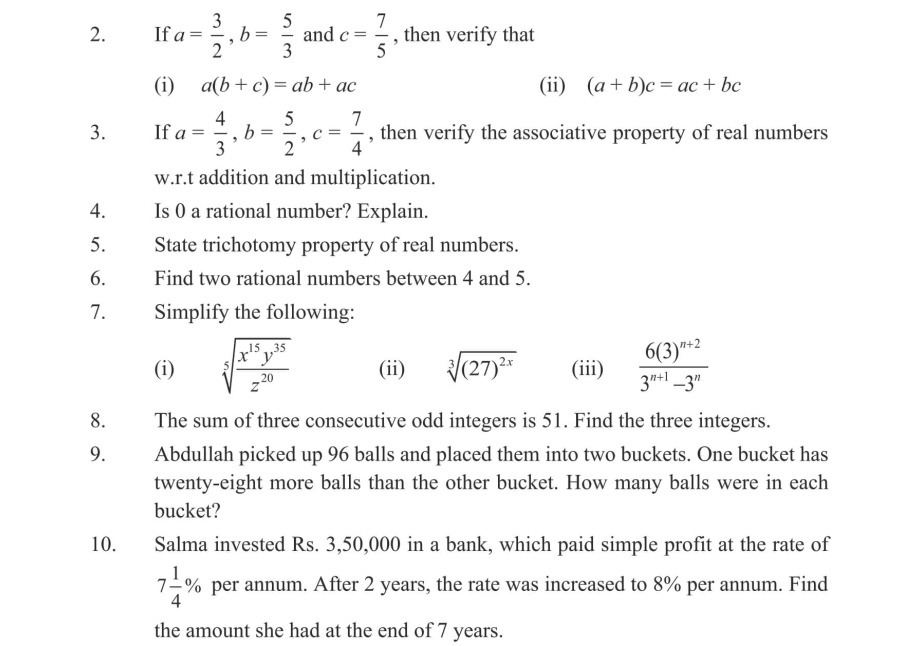
Question 2: Verify the Distributive Property
Given
a=23,b=35,c=57Verify:
a(b+c)=ab+ac
(a+b)c=ac+bc
(i) Verify
a(b+c)=ab+acLeft-Hand Side (LHS)
First, find
=35+57Taking the LCM (15),
=1525+21=1546Now,
a(b+c)=23×1546=30138=523Right-Hand Side (RHS)
Find
=23×35=25Find
=23×57=1021Now add them.
25+1021=1025+21=1046=523Since
LHS=RHS=523,the property is verified.
Final Answer
a(b+c)=ab+ac
(ii) Verify
(a+b)c=ac+bcLeft-Hand Side (LHS)
First,
a+b=23+35LCM (6),
=69+10=619Multiply by (c).
619×57=30133Right-Hand Side (RHS)
We already know
ac=1021Now,
bc=35×57=37Add them.
1021+37LCM (30),
=3063+70=30133Hence,
LHS=RHS=30133The property is verified.
Final Answer
(a+b)c=ac+bc
Question 3: Verify the Associative Property
Given
a=34,b=25,c=47Verify the associative property for:
(i) Addition
Verify
(a+b)+c=a+(b+c)Left-Hand Side
a+b=34+25=68+15=623Now,
623+47LCM (12),
=1246+21=1267Right-Hand Side
First,
b+c=25+47=410+7=417Now,
34+417LCM (12),
=1216+51=1267Since
LHS=RHS,the associative property of addition is verified.
(ii) Multiplication
Verify
(ab)c=a(bc)Left-Hand Side
ab=34×25=310Now,
310×47=1270=635Right-Hand Side
First,
bc=25×47=835Now,
34×835=24140=635Since
LHS=RHS,the associative property of multiplication is verified.
Final Answer
(a+b)+c=a+(b+c)and
(ab)c=a(bc)
Question 4: Is Zero a Rational Number?
Solution
A rational number is any number that can be written in the form
where
- (p) and (q) are integers, and
- (q\neq0).
Zero can be written as
where
- (0) is an integer,
- (1) is a non-zero integer.
Since zero satisfies the definition of a rational number, it is a rational number.
Final Answer
Yes, 0 is a rational number because 0=10.Question 5: State the Trichotomy Property of Real Numbers
Statement
For any two real numbers
a and b,exactly one of the following statements is true:
or
or
Only one of these relations can hold at a time.
Final Answer
For any two real numbers, exactly one of a<b,a=b,or a>b is true.
Question 6: Find Two Rational Numbers Between 4 and 5
Solution
There are infinitely many rational numbers between 4 and 5.
Two examples are
and
Since
and
4<4.8<5,both are rational numbers lying between 4 and 5.
Final Answer
4.2 and 4.8
Question 7: Simplify the Following
(i)
Given
5z20x15y35Formula
nam=anm
Solution
Apply the fifth root to each factor.
=z20/5x15/5y35/5=z4x3y7
Final Answer
z4x3y7
(ii)
Given
3(27)2xSolution
Since
we have
3(33)2x=336x
Final Answer
(iii)
Given
3n+1−3n6(3)n+2Solution
Factor the denominator.
3n+1−3n=3n(3−1)Substitute into the expression.
=2⋅3n6⋅3n+2Simplify.
=26⋅3(n+2)−n
Final Answer
Question 8: Find Three Consecutive Odd Integers
Given
The sum of three consecutive odd integers is
Find the three integers.
Solution
Let the three consecutive odd integers be
x,x+2,x+4.According to the given information,
x+(x+2)+(x+4)=51Combine like terms.
Subtract 6 from both sides.
Divide both sides by 3.
Therefore, the three consecutive odd integers are
15,17,19.
Verification
15+17+19=51Hence, the answer is correct.
Final Answer
15,17,19
Question 9: Balls in Two Buckets
Given
Abdullah picked up
balls and placed them into two buckets.
One bucket has
more balls than the other.
Find the number of balls in each bucket.
Solution
Let the smaller bucket contain
balls.
Then the larger bucket contains
balls.
According to the question,
x+(x+28)=96Combine like terms.
2x+28=96Subtract 28 from both sides.
Divide by 2.
Therefore,
Larger bucket:
34+28=62
Verification
34+62=96and
62−34=28Both conditions are satisfied.
Final Answer
34 balls and 62 balls
Question 10: Simple Profit
Given
Principal Amount
Rs.350,000Rate for first 2 years
Rate for next 5 years
Find the total amount after
years.
Formula
Simple Profit:
SI=100PRTAmount:
Solution
Step 1: Profit for the First 2 Years
Convert the mixed percentage.
741%=7.25%Simple profit:
SI1=100350000×7.25×2=Rs.50,750
Step 2: Profit for the Next 5 Years
SI2=100350000×8×5=Rs.140,000
Step 3: Total Profit
50,750+140,000=Rs.190,750
Step 4: Total Amount
350,000+190,750=Rs.540,750
Final Answer
Rs.540,750
Summary
| Question |
Answer |
| 8 |
15,17,19 |
| 9 |
34 balls and 62 balls |
| 10 |
Rs.540,750 |